
Do you know that the air in closed spaces is on average 10 times more polluted than outside? When we cough, sneeze or talk, we expel thousands (10,000 – 20,000) of droplets containing microorganisms. Although present forever, the problem of biological safety of indoor air came into the public spotlight with the pandemic caused by the SARS-CoV-2 virus. Solving this problem is a serious challenge and requires taking complex and, above all, effective measures, including changing the consciousness of individuals and changing the legal norms of countries and world society as a whole.
When disinfecting a space, the emphasis is mainly on the disinfection of floors, work surfaces and equipment, while completely ignoring air contamination, which remains one of the main problems in medicine, agriculture, the food industry, traffic and other areas. According to data from the World Health Organization, the causative agents of even 90% of registered infectious diseases are transmitted by airborne droplets. Bearing in mind that every closed space is a suitable environment for the reproduction of microorganisms, the existence of devices and systems for air disinfection in them is necessary in order to stop the growth of microbes.
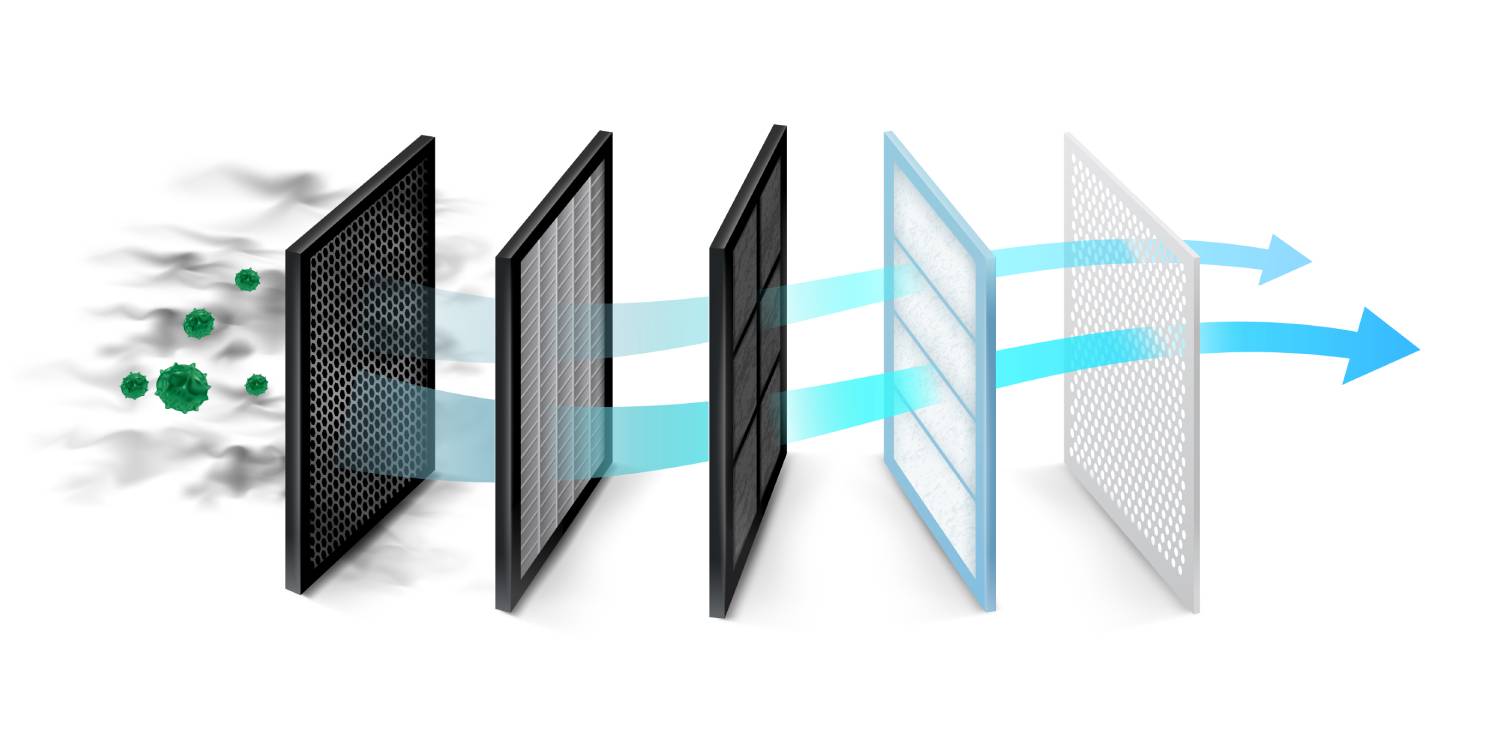
Today, various solutions for air disinfection can be found on the market, which are mostly characterized by insufficient efficiency. In addition, many solutions are technically outdated and, above all, unsafe for people and the environment. POTOK technology offers an innovative, energy-efficient and safe solution for air disinfection. POTOK air disinfection technology solves the problem of destroying microorganisms that characterizes traditional air purification methods and ensures the necessary biological safety of air in the most diverse areas (health and social institutions, food industry, public transport, public institutions, kindergartens, schools, sports centers,…). This technology is unique in that, during air disinfection, the bioinactivation (destruction) of microorganisms is first performed, followed by highly efficient filtration of inactivated biomass and aerosol particles, which ensures the removal of 99.99% of all types of microorganisms and viruses present in the air, including corona viruses. During inactivation, microbes are irreversibly damaged, so they cannot regenerate, which excludes the possibility of accumulation of living organisms in the device and their spread around the room. The efficiency and non-selectivity of the POTOK technology are made possible by the functional elements of the POTOK 150-M-01, which use a strong electric field to destroy the present microorganisms and viruses.
POTOK devices do not have expensive filters that need to be changed frequently due to the accumulation of microbes in them, but permanently destroy microbes without side effects. Simply put, if an infected person enters a space that has a POTOK device, it is almost impossible for someone to get infected no matter how much time they spend there because POTOK will KILL EVERYTHING HARMFUL IN THE AIR and thus maintain a healthy environment. For every square meter of space, or cubic meter of air, there is a dedicated device that guarantees maximum efficiency. The application of POTOK technology is absolutely safe for human health and the environment, because during its operation the equipment does not require the use of consumables, chemicals or a special method of disposal at the end of its working life, which is almost unlimited. Patented POTOK technology is the only technology successfully used in International Space Stations (NASA and Roskosmos). The effectiveness of the technology has been tested and recommended for use by numerous scientific institutes around the world, including the Faculty of Medical Sciences of the University of Kragujevac. Bearing in mind the changes caused by the pandemic and that there are increasingly loud rumors that in the near or distant future there will be an outbreak of a new epidemic or the appearance of the so-called superbacteria resistant to all known antibiotics, we must not allow ourselves to be unprepared again. In this preparation for a “new tomorrow”, the POTOK technology gives us a great advantage and guarantees a healthier life and survival.